
Business plans and forecasts
Lender-grade plans, not templates.
Most lenders want a business plan and a cashflow forecast before they will look at a new or recently acquired business. A template does not survive a credit team. Ours start from your actual accounts, at fixed fees from $850, and at the top tier include a full three-way model: a profit and loss, balance sheet and cash flow that actually reconcile, with assumptions a credit assessor can trace.

Tiers and fees
The Plan
The plan the lender asked for, without the padding.
$850
+ GST · $935 inc GST
- Written plan, typically 12 to 15 pages
- 12-month cashflow forecast
- Assumptions traceable to your actual accounts
- Revision round included
Bank-Ready Plan
The full written case for a bank. Our standard engagement.
$1,450
+ GST · $1,595 inc GST
- Full written plan, typically 20 to 30 pages
- 3-year cashflow forecast
- Revenue by stream from the actual accounts
- Tested against ATO small business benchmarks
- Revision round included
Three-Way Plan
The plan plus a full three-way model that reconciles.
$2,450
+ GST · $2,695 inc GST
- Everything in the Bank-Ready Plan
- 3-year three-way forecast: P&L, balance sheet and cash flow that reconcile
- Sensitivity testing on the key drivers
- Revision round included
Fees are shown excluding GST, with the GST-inclusive figure beside them. GST applies at 10%.
Every tier includes a revision round. The plan is not finished until it is ready to hand to a lender.
Already have a plan?
| Standalone product | Fee | Turnaround |
|---|---|---|
| Three-way forecast (P&L, balance sheet, cash flow), 3 years | $1,850 ($2,035 inc) | 7 business days |
| Annual Partner Refresh (existing clients) | $850 ($935 inc) | 5 business days |
Three-way forecast (P&L, balance sheet, cash flow), 3 years
- Fee
- $1,850 ($2,035 inc)
- Turnaround
- 7 business days
Annual Partner Refresh (existing clients)
- Fee
- $850 ($935 inc)
- Turnaround
- 5 business days
Fees are shown excluding GST, with the GST-inclusive figure beside them. GST applies at 10%.
The full fee schedule, including due diligence and finance documents, is on the pricing page.
The year after.
A forecast stops being useful the moment it stops matching the business. The Annual Partner Refresh is the ongoing relationship product: once a year Nick and his team rebuild yours against what actually happened, tied to a review call. How the year landed against the forecast, where your covenant headroom sits now, and what the numbers support if you want to borrow again. Most clients do this at the same time their financials are finalised, and it is the natural follow-on to any plan we build.
Annual Partner Refresh for existing clients: $850, 5 business days.
The refresh keeps the numbers current. If you want the thinking kept current too, a standing session with someone in your corner, that is The Sounding Board.
What the extra buys
A template bank-loan plan runs about $786. Ours is $1,450.
For template money you get the same document with a new logo and your name dropped in. It reads fine until a credit assessor asks where a number came from, and the file has no answer. A declined application costs you weeks, and the next lender starts by asking what went wrong with the first one.
The extra $664 buys the part a credit team can tell apart at a glance: figures built from your actual accounts rather than industry averages, revenue broken down by stream, a three-year cashflow instead of a one-year sketch, margins tested against the ATO's benchmarks for your industry, and every assumption traceable to a source document.
Template plan · ~$786
- Industry template, generic assumptions
- One-year cashflow, figures not traced to your accounts
- No benchmark testing a credit team can verify
- Written by people who have never sat on the lender's side
Bank-Ready Plan · $1,450
- Built from your actual accounts, revenue by stream
- Three-year cashflow forecast
- Tested against ATO small business benchmarks
- Every assumption traceable to a source document
Written by the desk that gets these approved.
Raising finance against the plan?
A business plan tells the lender where the business is going; a serviceability model proves the debt gets paid on the way. The two are built from the same underlying model and are usually bought together.
Inside a real plan
Evidence a credit assessor can check.
Two pages from documents prepared for live matters. Revenue broken down by stream from the actual accounts, and the business tested against the ATO’s own industry benchmarks, so the assessor can verify every claim rather than take our word for it.
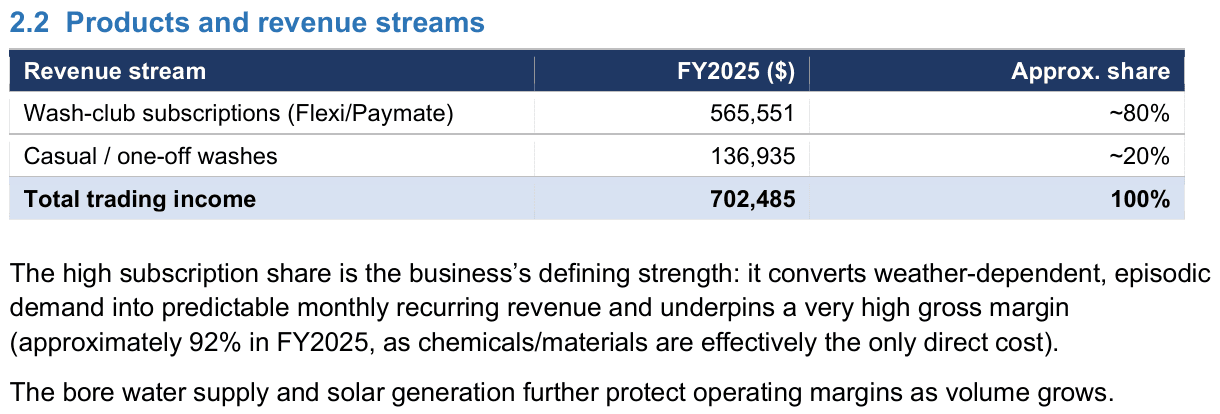
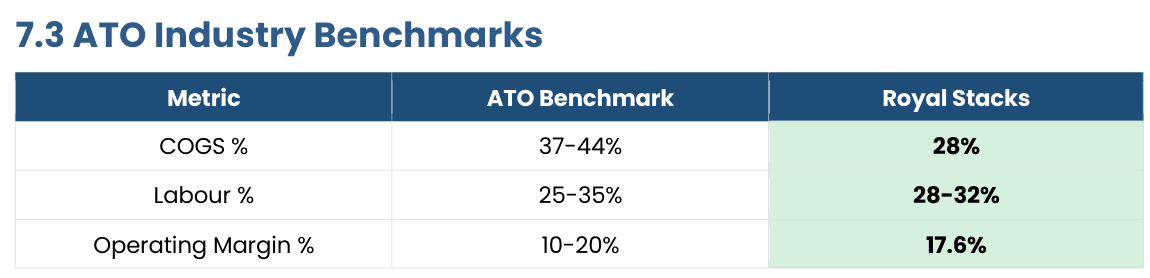
From documents prepared for live matters, client names removed and brands shown with consent. Figures relate to those matters.
It works
Declined first. Approved with a plan.
A US-based client wanted to buy an Australian franchise, and the first application was declined. The rebuild started with evidence: ATO benchmarks and comparable businesses, then a proper business plan, the financial models and our serviceability worksheet to demonstrate servicing. A major bank approved the finance on strong terms.
Been declined? How Submission Rescue works · The full case study
Details anonymised. Outcomes depend on individual circumstances and lender criteria.
Two ways this can work.
Referred to us for finance? You are in the right place either way. Either we arrange it, or we prepare the file for whoever does.
Have us arrange the finance
We build the analysis, write the submission and take it to the lenders who will actually do the deal, across 40+ of them. One team from the first set of figures to settlement, and one team holding the covenants after it.
Start a finance enquiryAlready have a broker or a banker you trust?
Keep them. We will build the file to the standard a credit team expects and work directly with whoever lodges it. Same models, same documents, same standards, and we do not take the lodgement on that engagement.
See the finance documentsWant a straight read on your deal?
Book a free call with Nick. Bring the numbers you have, and we will tell you the right service level and the fixed fee. No obligation.
Common questions
The Plan covers a straightforward request, where a lender or landlord has asked for a business plan with a cashflow forecast. The Bank-Ready Plan is our standard engagement for a bank application: a full written case with three years of forecasts, tested against ATO small business benchmarks. The Three-Way Plan adds a forecast profit and loss, balance sheet and cash flow that reconcile, which is what a credit team wants on bigger or more complex applications. Not sure? Book a call and we will tell you straight.
The starting point. A template starts with someone else's words and drops your name in. Ours starts with your actual accounts: revenue broken down by stream, margins compared against the ATO's own benchmarks for your industry, and assumptions a credit assessor can trace back to source documents. The writing matters less than the evidence behind it.
A three-way forecast projects the profit and loss, the balance sheet and the cash flow together, so the three statements reconcile. Most cheap forecasts are a sales projection with expenses taken off. A credit assessor wants to see what happens to working capital, tax and debt balances as the business trades, because that is where repayments actually come from. The balance sheet is where a forecast falls apart if the numbers were made up.
Every tier includes a revision round after you review the draft. If the lender or your broker comes back with questions on the plan, we adjust it. What we do not do is change the numbers to suit an outcome. Every figure has to trace back to your records or to an assumption we have agreed and written down.
The Plan takes five business days, the Bank-Ready Plan seven, and the Three-Way Plan ten, counted from the standard information request being met. Expedited delivery is available for an additional 30%.
The price on the site is the price, and it is the same whether or not you use us for the lending. Our fees stay fixed and non-contingent either way, so nothing you are quoted moves with a finance decision you have not made yet.
No document guarantees an approval, and you should be wary of anyone who says otherwise. What a properly built plan does is remove the reasons credit teams say no to businesses that actually service: unevidenced claims, forecasts that do not reconcile, and questions the file never answers. Lending decisions rest with the lender and depend on your circumstances and their criteria.